The Alien at the Firm.
What a Home Electronics Project Taught Me About the Future of Law Firm Screw Ups
The Printed Circuit Board
In my parents' basement back in New Jersey lives an unfinished model train set. My dad was halfway through a years-long build of this enormously complicated miniature construction project when he was involved in an unrelated accident. Work came to a grinding halt in the basement. In the years since my dad's accident, and just like the king's men standing over a broken Humpty Dumpty, no one has been able to figure out how to get the trains back together again.
I am not a model train enthusiast, but I am an amateur mapmaker and a tinkerer. I started with a photograph of the mimic panel that my dad had drawn which traced the route of every track and switch on the train set.
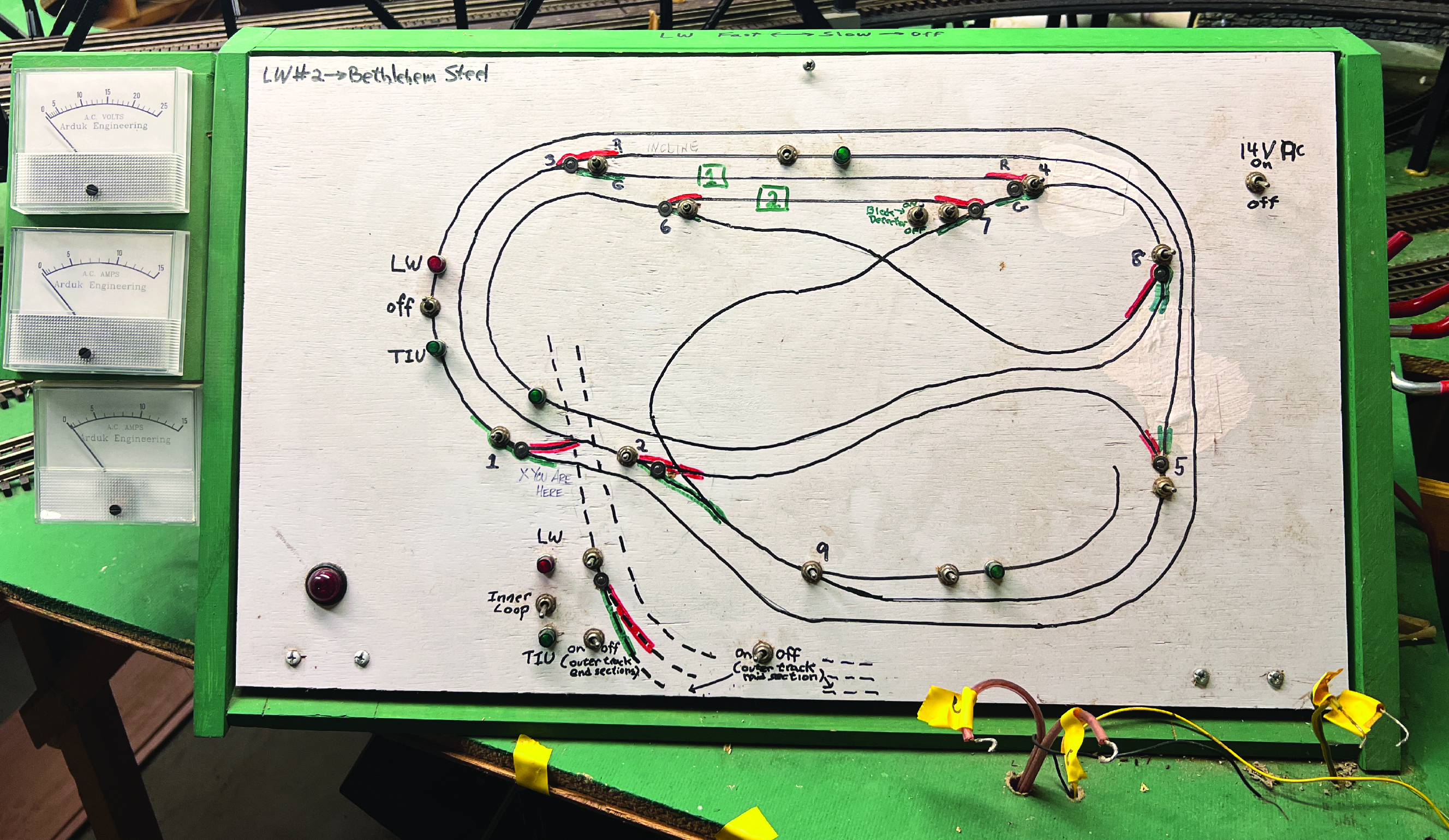
My initial ambition was to create a nice map of the train layout, but about halfway through that project, inspiration struck. I asked Claude if it could help me turn the map I was making into an actual living replica of the train set in the basement. And of course you know what Claude said.
We can do this!
Over the next couple weeks, I collaborated with Claude to create the blueprint for an elaborate printed circuit board (PCB) design, complete with 298 LEDs spaced carefully along the tracks that would light up one by one and replicate the path of the now dormant trains moving along the infinite loop that my dad had incorporated into his track designs. We programmed a tiny ESP computer and I learned about electronic parts like resistors and capacitors, laying it all out with some software built by MIT called KiCad.
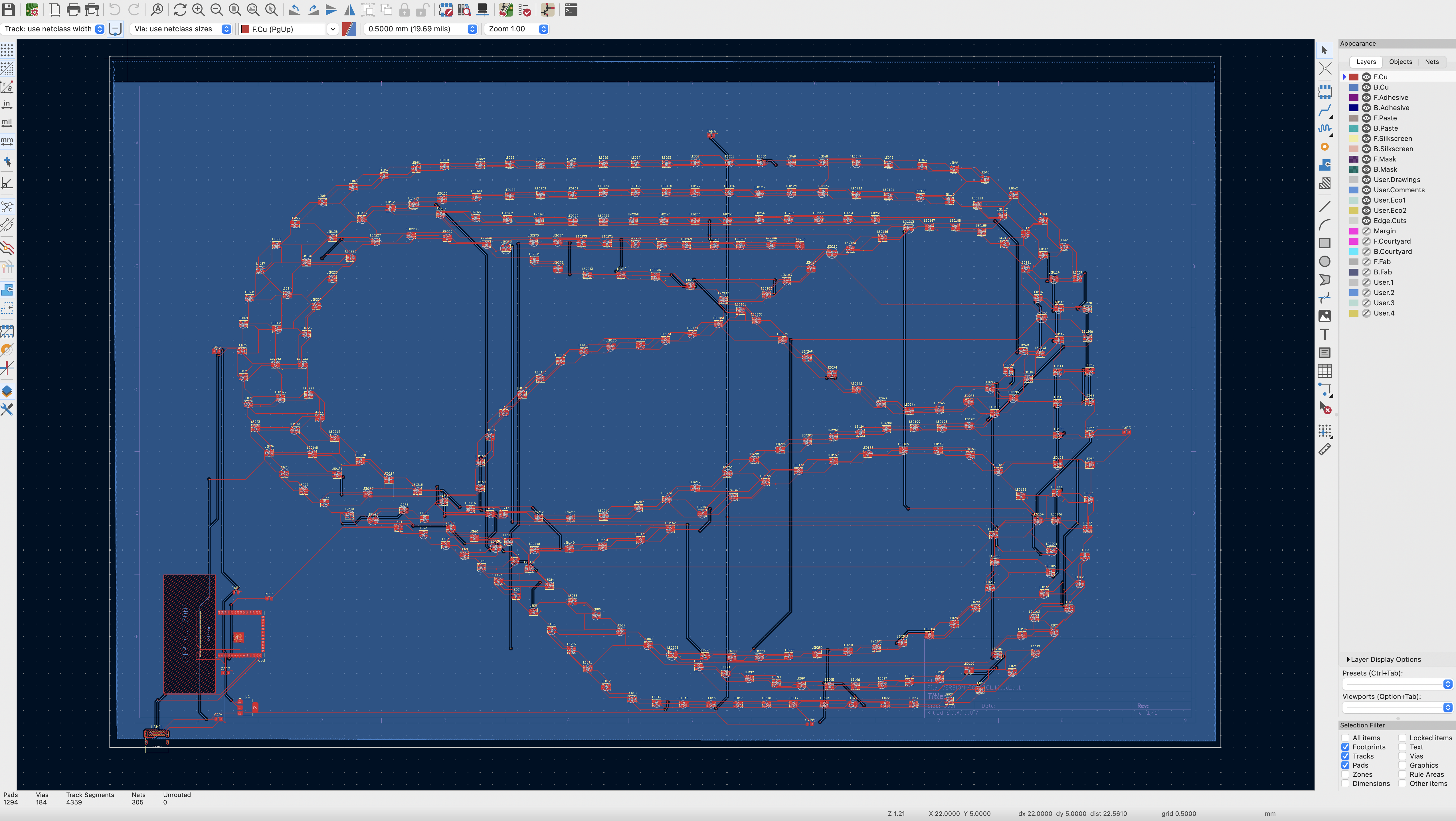
When the PCB design was complete, it was time to leave the safe confines of my Claude-fueled collaboration bubble and find someone who could actually build this enormously complicated PCB train map. A quick quote from several US manufacturers came in at about $5,000 (if they could do it at all). That's when Claude helped me find PCBWay, a printed circuit board fabrication and assembly shop based in Shenzhen, China. For about 1/10 of the price (plus a steep tariff hit) PCBWay could bring the train map to life! With Claude as my wing-thing, I carefully zipped a Byzantine collection of PCB design files and sent them buzzing off to Shenzhen. There was silence in my Claude cocoon. We had done it!
Several weeks later, I started receiving confused emails from the team at PCBWay. Part of the confusion could be blamed on the language barrier. But English to Mandarin translation is an easily solvable speed bump. What was happening here was a much deeper failure to communicate. The first major problem was a picture I received of my printed circuit board designs brought to life! There it was in a factory in China. Unfortunately also in the picture, was the hand of a Chinese technician holding a tiny LED (recall there were 298 of them in my design) with four even tinier legs sticking out of the LED. What the picture clearly showed was that the dimensions of the four holes drilled into the board where each LED was supposed to be soldered didn't match the dimensions of the actual real-world LED that the tech was holding. And since there were 298 LEDs in my design (each with four legs of their own) this meant that there were no less than 1,184 incorrectly drilled holes in my brand new $800 printed circuit board.
I fired up Claude, who helpfully read the email from PCBWay, thought about it for several seconds, and promptly admitted to fucking up. Recall that we had used MIT software called KiCad to design the circuit board. One reason that KiCad is fantastic (I had learned during this journey) is that it comes preloaded with the exact specifications of just about every electronic component on earth that could be contained on a printed circuit board, including the exact dimensions and spacing of the feet attached to the particular LED model that we had used 298 times for our train map. It turns out that during the design process, Claude had decided to manually override the proper dimensions for each and every LED with a new hallucinated set of dimensions that weren't based in the real world where PCBWay was trying to build the train board.
This is Claude's expert diagnosis of its own screw up:
The problem is clear now. This LED footprint does NOT match any standard SK6812 variant. The footprint I created for you was wrong. It doesn't match any real LED that exists. The status bar saying “3.2x2.8mm” was just a text description I added — it didn't reflect the actual pad geometry….
With Claude's help, we fixed the LED dimensions in the PCB designs, sent $371 extra dollars to PCBWay, and they got to work making new circuit boards. Several weeks later, I received another email from a perplexed Chinese technician informing us that the firmware which Claude had expertly programmed couldn't actually be loaded onto the tiny ESP computer soldered onto the board because we had selected a USB-C plug that could only be used to supply power, not data. We had genius code, but literally no way to load it onto the computer. Claude quickly diagnosed the problem upon reading the newest email and helpfully drafted a response translated into Mandarin. I sent several hundred additional dollars to China and PCBWay got to work on v.3 of the circuit boards.
Several months later (after navigating two more cycles of mistakes with our circuit board designs and with me now feeling very poor) the working boards arrived from Shenzhen. And they are amazing. We did it! Claude had made the impossible possible. But it certainly didn't make it easy. Or cheap.
Your Screw Up Pattern Recognition is Broken
Traditional law firms still train their people through the apprenticeship model. Young lawyers graduate, pass the bar, and start their first firm job with virtually no actual skills that make them valuable lawyers. They get thrown into the fire, mess up royally at first, and slowly get more competent over time (or they quit or get fired). These young lawyers get more competent because they learn what to do and what not to do from the more senior lawyers at the firm. Turning this proposition around: by the time you get to be one of those senior lawyers, you have at least a decade of experience knowing all the different ways junior lawyers tend to screw things up. When it comes to human fallibility, your pattern recognition is top-notch.
Now enter AI-powered legal tools, which are more than competent at doing most junior-level legal tasks. For example, recent benchmarking studies establish that AI tools are more accurate at legal research than human lawyers.1 But here's the thing these benchmarks miss: AI competence on a particular task doesn't correlate to human competence on that same task. AI tools screw up too. They just screw up differently. And when AI tools do screw up, they do it confidently. Plausibly. Coherently. And in ways and places that no junior associate would.
Researchers have a name for this. They call it the “jagged frontier.”2 AI is dramatically better than humans at some tasks and dramatically worse at adjacent tasks that look similar, but are somehow much harder for an AI alien brain legal tool. When it comes to many legal tasks, there's no smooth gradient from “easy” to “hard” the way there is for a human lawyer.
Which is how this ties back to my circuit board. I don't claim electrical engineering pattern recognition anywhere near a senior lawyer's expertise. But I did run multiple rounds of quality checks before sending my designs to Shenzhen. It just didn't occur to me that Claude could be smart enough to write a brilliant piece of firmware and dumb enough to pair it with a USB port that couldn't load it. It also didn't occur to me that the same model that could design a 298-LED circuit board could also invent the dimensions of each of those LEDs out of literal thin air. Claude has alien intelligence that is so damn smart and so damn dumb at the same time.
Law firms should embrace AI tools. They will make legal work faster, better, and (most importantly) cheaper, which makes good lawyers more accessible to more people. But the traditional apprenticeship model isn't going to catch the new failure mode these AI tools are bringing into the law firm. Decades of refined intuition about where junior lawyers screw up is mostly the wrong intuition for where AI screws up. The pattern recognition senior lawyers have honed over their careers is worse than useless in a Harvey and Legora future because it tells them to look in the wrong places.
Building New Pattern Recognition Skills
Here are two practical tips for working with your new AI associates.
Verify the AI's sources, with a different AI
AI doesn't fail randomly. It fails most reliably where it should have pulled from a verifiable source and chose to fabricate instead. In my PCB project, Claude overrode the manufacturer-verified LED dimensions sitting right there in the design software and invented its own. A human engineer wouldn't have thought to do that. It's an alien screw up.
The legal analogue is everywhere there's a source of truth the AI could be wrong about — a cited case, a number in a closing schedule, a factual claim about the deal record. The cheap, fast review move is to spot-check those source-backed claims, not the legal analysis.
But here's a slightly counterintuitive practical trick. Pull in a second AI associate to fact-check the work of the first one.
Don't ask the same AI session to fact-check its own work. It will defend its prior answer rather than catch its error. Use a different tool, or at minimum a fresh chat session, and ask it to check the citations and source references independently. Because every fresh chat session comes with zero context of the previous session, it means that AI tools are actually pretty good at fact-checking the work of other AI tools.
Know when you're in the “alien intelligence” screw up zone
AI tools are confident by default. They sound the same whether they're drawing on 1,000 cases or 1. The tone of the output is structural, not a signal of how much the model actually knows. This is the single most counterintuitive thing about working with these tools.
Harvey and Legora are excellent on heavily-cited sources: federal case law, Delaware corporate law, mainstream regulatory regimes. They degrade sharply on niche jurisdictions, recently-amended regimes, novel fund structures, and cross-border intersections. This is exactly the small percentage of legal work where true value lies. And your AI associate will degrade without warning. Same tone, same fluency, same authoritative citations, complete bullshit.
Here's the practical move:
First, learn the shape of where your AI tool's training data is dense versus thin. As a rough heuristic: if you're working in a jurisdiction with limited public case law, in a shifting legal area, or at the intersection of multiple jurisdictions, you're in the danger zone.
Second, if you think you're in the screw up danger zone, push the AI to ground its claims in specific statutory provisions or named cases. Literally ask, “What are your specific verifiable authorities?” If it can't answer this question to your satisfaction — because there is nothing to retrieve — you're in the danger zone, and the substantive analysis expertly delivered by your AI associate is suspect, too.
- Vals AI, VLAIR – Legal Research (October 2025). The study tested three legal-specific AI tools (Alexi, Counsel Stack, Midpage) and ChatGPT against a human-lawyer baseline on 200 legal research questions developed with input from US firms; the legal-specific tools scored 76–78% and ChatGPT 74%, all above the 69% lawyer baseline. ↩
- Fabrizio Dell'Acqua et al., Navigating the Jagged Technological Frontier, Harvard Business School Working Paper No. 24-013 (2023). ↩